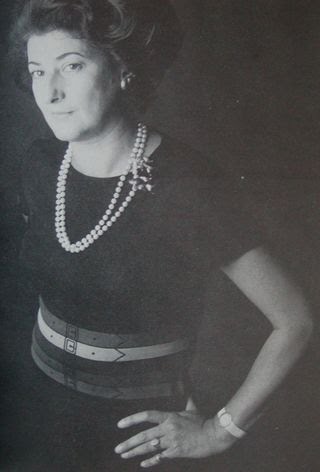
 Roberta di Camerino, circa 1970, wearing a dress of her own design with a printed, trompe l'oeil 5-buckle belt; image courtesy of irenebrination.typepad.com
 Roberta (Giuliana) di Camerino in 2005, note the cardigan with panels of silk twill printed with trompe l'oeil effects; photo, legacy.com
 Fashion today is so democratic. The most prestige houses often have entry level goods such as fragrance, scarves, key chains, or limited edition diffusion lines. Greater availability raises awareness of a brand and brings in a younger customer base, but in the 1960s and before, high fashion had an entirely different demographic, and it was much more exclusive. Unlike today, Vuitton and Gucci boutiques were not in every major city around the globe. While more customers have access to good design and to quality, there is a certain loss of mystique when goods are readily available both in person or through Internet purchase.
One of the very creative designers who never really became a household name, but held a special place in the hearts of the fashion cognoscenti, was Roberta (Giuliana) di Camerino(née Coen) of Venice. While recently researching vintage di Camerino pieces I discovered, I reread her fascinating biographical details but was saddened to learn that this exceptional designer died in spring of this year. She passed away exactly 3 months after Alexander McQueen, but her death was not reported or discussed in many fashion or news forums. The two designers couldn’t have been further apart in design philosophy. McQueen was a still young rebel, and his most documented and memorable clothes were conceptual art to be observed. They were dark, often sinister, and difficult to wear. Camerino clothes and accessories, while unique and creative, were eminently wearable and light hearted. As a Jew, she found it unecessary to create anything sombre after living through the fear, darkness, and pain of the war.
Her fashion house was founded in 1945, and still exists in Venice. Imagine a designer working successfully in a signature style for 70 years. That has to be a record of some sort in the world of fashion, where designers fall quickly out of fashion. She was best known for her superb velvet handbags, and for interesting trompe l’oeil effects that appeared as pleats, buttons, buckles, saddle stitching, pockets, and other details, but were in fact printed on the textiles of accessories and clothing. Her work made use of centuries old Venetian crafts, artisans, and traditions. The pigments, textiles and hardware were of the finest quality done in ancient, historic workshops. The fittings were made by the same artisans who made fine bronze hardware and mounts for Venetian gondolas. The artisanal, two centuries old textile firm of Bevilacqua, wove Camerino's velvets on ancient hand operated looms that have made fabics for the Vatican and the most prestigious and historic Italian villas and palazzi, not to mention palaces and embassies around the globe.
 shop facade of Bevilacqua, supplier of velvets for Roberta di Camerino's signature purses, and purveyor of deluxe handmade textiles for 200 years; the shop is in the centre of old Venice
http://www.bevilacquatessuti.com/indexingl.htm
 early 1970s dress printed to look like a sporty nautical blazer, necktie, and pleated skirt ; CoutureAllure.com
a trompe l'oeil effect evening gown printed to appear as wrapped and draped silk jersey; image from CoutureAllure.com
What is wonderful about Roberta di Camerino is that the look is original and distinctive, and has maintained a signature look throughout its long history. I would put this design house in the same league as Chanel, Pucci, Gucci, Vuitton, Lacoste, Burberry, and Hermès, but prior to the global distribution of today. You see it, you know what it is, and a venerable and prestigious history is evoked.
There have been two exhibitions of her work; in 1980 at the Whitney, and in 1999 at the Fashion Institute of Technology. In the 1950s her bags were carried at Neiman Marcus, and like Chanel (in 1957), Yves Saint-Laurent (in 1958), and Dior (in 1947), she was honoured to receive their fashion award in 1956, along with Cecil Beaton. Undoubtedly, there will be exhibitions and perhaps a book in the near future, as her recent death has brought about greater interest in her work.
 Roberta di Camerino accepting her Neiman Marcus award with Cecil Beaton, 1956; note the black cut velvet evening bag of her own design; image courtesy irenebrination.typepad.com
 What is important about di Camerino as a designer? What sets her apart from the hundreds of others who struggle to reach success in this unforgiving and competitive field? The designs were absolutely unique but wearable. They were of the finest quality. Essentially, she took centuries old crafts and concepts (printed and woven Venetian velvet, and trompe l’oeil), and made them relevant and amusing for the 20th century woman. She was commercially successful but the products were never ubiquitous. Her work promoted Italian and Venetian heritage, skills, and products. In an age of excessive self promotion, she subtly changed her real name for commercial use, in order to maintain a degree of privacy for herself and her family, and preserve a sense of discretion and mystique. I am reminded of other great designers such as Mainbocher, Mad Carpentier, and Louiseboulanger who also adapted family names for business purposes, creating a sort of sartorial nom de plume, or rather a nom de ciseaux.
A wonderful story about her has often been repeated. Di Camerino was a client of Chanel. It isn't surprising, as she admired quality, fine workmanship, wearable design, and fashion talent. She was upset about the blatant copying of her distinctive velvet bags. At the time, they were seen on the arms of stylish women such as Grace Kelly, Soraya, Maria Callas, Sophia Loren, Paola of Belgium, and Elizabeth Taylor. Chanel told Camerino that she should only cry when they stop copying her. Her influence is seen in many vintage inspired fashions today. The designs of Moschino have shown Camerino influenced pieces, especially things with whimsical trompe l'oeil, in several collections over the past 25 years. The house of Moschino has also maintained a powerful image that is both humourous and ironic, and at this time is the one house that best carries on the sheer inventiveness and wit of di Camerino, and at times, Elsa Schiaparelli.
A wonderful story about her has often been repeated. Di Camerino was a client of Chanel. It isn't surprising, as she admired quality, fine workmanship, wearable design, and fashion talent. She was upset about the blatant copying of her distinctive velvet bags. At the time, they were seen on the arms of stylish women such as Grace Kelly, Soraya, Maria Callas, Sophia Loren, Paola of Belgium, and Elizabeth Taylor. Chanel told Camerino that she should only cry when they stop copying her. Her influence is seen in many vintage inspired fashions today. The designs of Moschino have shown Camerino influenced pieces, especially things with whimsical trompe l'oeil, in several collections over the past 25 years. The house of Moschino has also maintained a powerful image that is both humourous and ironic, and at this time is the one house that best carries on the sheer inventiveness and wit of di Camerino, and at times, Elsa Schiaparelli.
 a soignée Roberta di Camerino with her iconic velvet bags, late 1950s; like Chanel, her pearls were a constant; image courtesy of irenebrination.typepad.com
During the 1970s in Toronto, Canada, a handful of her designs were carried at the old flagship Eaton’s (a cross between Macy’s and Bloomingdale's) department store in Toronto. I remember the first time I saw them around 1975, and I was intrigued by the trompe l’oeil effects that made them unlike anything I had ever seen. Within the last decade, Camerino velvet handbags were available at Canada’s most exclusive clothing store, Holt Renfrew. As beautiful as they were, the luxury accessory client in North America seemed pretty much devoted to the more widely promoted luxury brands, and sadly Holt’s ceased to carry Camerino's wonderful printed velvet doctor-style satchels.
Splendid examples are available on eBay and through vintage clothing shops. For anyone who appreciates Italian heritage, unique design, quality, and an amazing history, a Roberta di Camerino bag or trompe l’oeil scarf or dress is a fantastic addition to the wardrobe. And as serviceable as black is, isn't nice to know that there are colourful alternatives?
 A cotton canvas tote bay from Old Navy, spring 2010 collection, showing the trompe l'oeil effects that were first shown in the designs of Roberta di Camerino, photo SwF
 detail of silk screened faux saddle stitching in the above tote bag, photo SwF
 printed wool dress, with boldly graphic draped blowing skirt effect, circa 1980, this very representative piece is available at mlvintage.com
 the classic Camerino 1950s velvet satchel that was worn by Elizabeth Taylor and Grace Kelly; the designs were reissued in the 21th century, riding the wave of interest in vintage fashion; CoutureAllure.com


