Showing posts with label Christian Dior. Show all posts

Wednesday, May 9, 2012

Roger Vivier Exhibition at the Bata Shoe Museum, Toronto


the charming Sonja Bata wore a beautiful light coral suit and the discrete Order of Canada decoration on the night of the exhibition opening

May 8th, 2012, was the opening of the Roger Vivier exhibition at the Bata Shoe Museum in Toronto. Vivier was called the “Fabergé of Shoes” and he worked with Christian Dior, who allowed Vivier’s name on the label along with his own, the only co-creator that was permitted this honour. Both were great connoisseurs of the arts, with a deep respect for the arts and crafts of 18th century France. In fact, many of the clothes of Dior and shoes of Vivier were modern designs with influences, construction, or proportions of the 18th century. Dior’s label incorporated a Louis XVI style frame, Vivier’s had his name written in 18th century style copperplate script. Either designer could be over the top with embellishment and luxury, but both could work equally well in the most crisp, minimalist aesthetic. It was a creative partnership made in heaven.

Roger Vivier's salon, circa 1990; note the 18th century room rendered modern and less formal with terra cotta tile floor, absence of curtains, and a lack of moldings; it retains a whisper of the 18th century with the aristocratic room proportions, mullioned windows, a few choice antiques, and a very balanced arrangement of furniture, from Roger Vivier by Pierre Provoyeur, Éditions du Regard, 1991


a pair Louis XV chinoiserie red lacquer cabinets lend balance on the sofa wall; opposite the low table is a pair of black leather Mies designed Barcelona chairs, from Roger Vivier by Pierre Provoyeur, Éditions du Regard, 1991

Roger Vivier had admirable taste in realms other than the design of shoes. His home was a very modern mix of 18th century antiques and 20th century classics. It looked right because he maintained a disciplined palette of cream with black and red lacquer accents, and arrangements were often very balanced and symmetrical. The 18th century was important, but was not presented as a period room reconstruction. And for someone who designed the world’s most extravagant and often possibly conceptual (before this category of art had been thought of) shoes, in any photos I’ve seen of his own feet, they appear to be shod in quite broken in American penny loafers. Like his next creative collaborator, Yves Saint-Laurent, he understood the enduring appeal of classics high and low, and there was no need to reinvent, only to see things in a slightly different colour, proportion, or material.

The opening night reception of this exhibition was very elegant and enjoyable. The fashionistas were in full force. Socialites Catherine Nugent, Westons, and devoted fashion animal Suzanne Rogers were present. Grande dame Sonja Bata spoke with great charm at the introduction and related the designs of Dior and Vivier to the late 1940s when she was a young bride (she was married in 1946, the year before Dior’s revolutionary “New Look”), and how joyful and fresh they appeared in contrast to the broad shouldered utility wear of the war years. She also mentioned that, “The shoes weren’t that comfortable,” which brought unanimous laughter from the audience. French consulate representatives, prominent journalists Jeanne Beker, Bernadette Morra, and David Livingstone also attended. Museum curator Elizabeth Semmelhack spoke of the genius of Roger Vivier and was on hand to answer questions and sign copies of her excellent book on the designer. Guests listened to a French style chanteuse with piano accompaniment and Moët & Chandon flowed very freely.

The party was so much fun that it was difficult to tear one’s self away to view the spectacular shoes. I did look at them with great interest, but will have to revisit to contemplate their amazing design without the party crowd. This is not a show just for admirers of fashion, because these shoes, especially some of the more fantastic, are great works of art in themselves, as much to be admired as objets, as to be worn. An interesting anecdote was told regarding some of the fantastic, embroidered and beaded masterpieces. A woman returned with one that lost some of the applied jewels and Vivier’s manager, Michel Brodsky responded, “But Madam, you wore them!”

This shoe will be running for the next eleven months, and is most highly recommended, as is a visit to the Bata Shoe Museum at any time. The Bata Museum is most conveniently located, steps from the St. George subway station and University of Toronto campus.

Portrait of Roger Vivier, 1990, from Roger Vivier by Pierre Provoyeur, Éditions du Regard, 1991
Roger Vivier paper collage, 1991, Bata Museum
bottine in style of Madame de Pompadour, blue silk satin, ribbon, lace, and sequins, 1961, Metropolitan Museum of Art
a showstopper in the exhibition was this pink satin sandal; it deserves to be put into production; with embroidered butterfly ornament, a 1953 sample, collection of the Bata Museum
early 1960s stilletto pump, covered entirely with iridescent feathers...a conservator's (and conservationist's) nightmare
these 1964 gold velour mules feature a very elongated tongue; because it was so visually dramatic, Vivier was frequently photographed with it; collection of Maison Vivier
a unique pump of pink fur (not sure if it is mohair or Orlon) with paste jewel and a unique Vivier heel, 1962-1963, Metropolitan Museum of Art
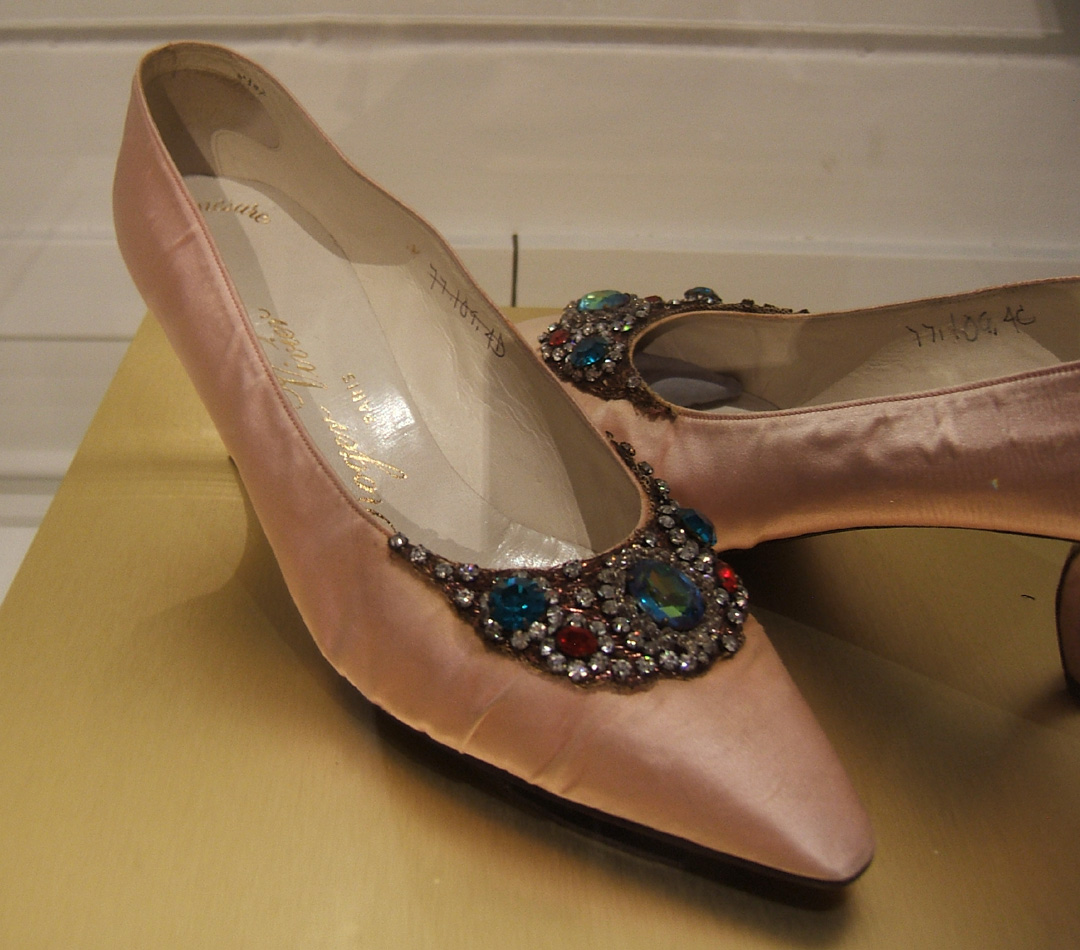
pink silk satin with paste jewel ornamentation, early 1960s
silk satin with silver embroidery and pearl pendant drops, 1959, Metropolitan Museum of Art
gold frame from the museum exhibition, done as a silhouette of a Louis XVI Dior salon frame with a bow at the top
detail of Roger Vivier's own penny loafers and Argyle socks, from the above portrait
the author's own loafers which he wore to this exhibition opening; I'll consider it my 'umble hommage to the master
gold satin pumps with gathered detail at the instep; these were bespoke, using same material as the dress they were worn with, for Princess Lilian of Belgium, circa 1953-1955
a departure from the 1950s are these mid 1965 pyschedelic print Pilgrim pumps with matching handbag
vivid printed silk pumps with one of Vivier's unconventional and very original polchinelle heels which lend the wearer a stylishly exotic air, 1961
silver leather high top sandal, with African mask-like ornament, likely contemporary with Yves Saint Laurent's tribal collection of 1966; I am reminded of the tin man in The Wizard of Oz
these exceptional pumps had a faintly Persian and 18th century look; certainly these are worthy of display in a vitrine; Marie-Hélène de Rothschild sometimes wore such dramatic shoes to her fantastic parties of the 1960s and 1970s; the donor of these shoes, society event and interior designer Valerian Rybar, was a good friend and collaborator with the famed Rothschild matriarch; 1962, collection of the Metropolitan Museum of Art
the conventional black pump is updated and becomes unexpected, and slightly perverse with sides of transparent vinyl; peek-a-boo was a style statement in the mood of being anti-establishment in the 1960s

this magazine advertisement represents a collaboration of three creative geniuses of design; shoe design by Roger Vivier to accompany the fashions of Christian Dior, depicted in this illustration by René Gruau, in which a delicately shod foot steps on a rose, all within the Louis XVI frame favoured in the couture salon and boutiques of Christian Dior

Vivier mule with an Indo-Persian feeling, embroidered with pearls and embellished with a wired, tiara-like ornament on the instep, 1959, Metropolitan Museum of Art

 unless credit is specified, photos by Square With Flair

Tuesday, October 26, 2010

Skull and Crossbones; the macabre fashion shows no sign of dying

children's hoodie by "725 ORIGINALS"; photo SwF
☠ ☠ ☠ ☠ ☠ ☠ ☠ ☠ ☠ ☠ ☠ ☠ ☠ ☠ ☠ ☠ ☠ ☠ ☠ ☠ ☠ ☠ ☠ ☠

Give the blog a bone. As Halloween approaches, we are exposed to images of death and spirits on decorations and in illustrations. In the past, skeletons and skulls were traditional motifs of this holiday, along with owls, pumpkins, ghosts, and witches, but the skull motif seems less evocative of Halloween because we see it throughout the year.

In my book, wearing a skull and crossbones is associated with negative things such as 1) convicts, toothless pirates, and rebel outlaw biker gangs and, by association, organized crime and drugs, 2) nuclear and hazardous chemical waste, 3) a motif on tombstones and memorial monuments from the 15th to 18th century, 4) toxic household products such as drain cleaner or chlorine bleach, 5) Nazi SS regalia and medals. Skeleton chic seems to have arisen simultaneously with the current, insatiable taste for tattoos. Why, when there is so much violence, darkness and crime in the media and in entertainment such as video games and music, is it necessary to add a negative aspect to one’s daily presentation of self?


detail of a label of Recordsol Paint Thinner Poison showing skull and crossbones symbol, early 1990s; photo SwF

Earlier this year, I viewed television news coverage of people protesting against a Whitby, Ontario waste incineration facility. One person carried a large sign with the skull and crossbones symbol on it. In western culture, one becomes aware of this symbol from a very early age. Children see it associated with villains and evil as is seen in many Disney films and it has become shorthand for death or danger. The message that the skull on the protesters sign conveys is, “Incineration equals death," or, "Beware of toxic effects on our health.”

In a recent Canadian criminal trial, a father was convicted of murdering his young daughter. Entering the courtroom, he wore a grey sweat shirt with a very large skull motif on the chest. Amazing that none of the journalists covering the case commented on the irony of it. Certainly his solicitor wasn't dispensing any sartorial suggestions. Is it that the "numb skull" is now so ubiquitous we barely notice it, let alone make the association with toxic materials, death, or criminals?

The motif was first appropriated by Goths and then high stylers like Alexander McQueen. Subsequently it filtered into mainstream fashion, and went from being predominantly on male clothing and moving to young women's wear. It is now available from street market vendors as the least expensive, mass produced, Asian manufactured clothing. The last group to take up the bone head was the young; it now emblazons the clothes of toddlers to teens. Symbols of death, decadence and toxic dangers being worn by children is a disturbing trend. I don’t understand what is appealing about youth, our hope for tomorrow, wearing the skull and cross bone motif. Surely our future isn't that bleak.

In the 1960s and 1970s, young people wore daisies, yellow happy faces, and peace signs. Nowadays many of them wear tattoos, piercings, and skulls. What does this say about our culture? What does it say about parents who allow impressionable children to wear these subversive motifs? I suppose that in the development of the adolescent mind, I can understand the proclamation of independent thinking and a wish to assert identity, and independence; thus we see the edgy, rebellious trend of youth wearing skulls, smoking, and listening to antisocial music with profanities. But after half a decade, I cannot see that it still has the desired anti-establishment effect.

For the past few years, the skull and cross bone motif has been seen in various forms in fashion. When I was in Paris two years ago, I visited the Dior Joaillarie Boutiques on Place Vendôme and on Avenue Montaigne. I was surprised, actually I was disappointed, to see that talented Dior (formerly Chanel) jewellery designer Victoire de Castellane has included pieces with jeweled skulls in the Dior precious jewelry collection. Considering that Dior is associated with refinement, quality, and taste, and is the paragon of Paris couture, I was perplexed by this inclusion. If it was intended to shock and surprise, I don't think that any fashion feathers were ruffled, although for me it would certainly detract from the grace and prestige of Dior.


Tête de mort” pendants/charms(☠), Dior Joaillerie design, 2004, by Victoire de Castellane detail from a child's hoodie by "725 ORIGINALS", photo SwF

As the motif becomes more and more familiar, and loses shock value, I wonder if it will take on a different, less sinister aspect, somewhat like the skull and skeletons one sees everywhere in the Mexican Dia de los Muertos celebrations

Friday, April 30, 2010

Consider the Lilies-of-the-Valley

Spring 1992 Gianfranco Ferré for Christian Dior, oversize 9" corsage/pin spray of silk lilies-of-the-valley from Paris made by the Lemarié atelier, purchased at Creed’s of Toronto


The First of May is an important day throughout Europe. In France, 'le premier Mai' is characterized by the centuries old custom of sidewalk vendors selling charming little bouquets of lilies-of-the-valley.

The earliest May Day festivities were pre-Christian, and related to Flora, the Roman goddess of flowers. Countless legends in many cultures, religions, and historic periods are based on the fanciful origins of lilies of the-valley, convallaria majalis. In Christian legends, it has been called, ‘Our Lady’s Tears.’ In Christian iconography, it is representative of modesty or humility. In the language of flowers it means good luck, and the return of happiness.

The lily-of-the-valley is an old fashioned flower seldomly encountered nowadays. In Victorian and Edwardian times one could buy it at florists. In France, it is still commonly sold at florists in May, but in North America, selections at flower shops are usually limited to tulips, roses, mums and the now ubiquitous potted phalaenopsis orchid.

At one time, 'muguet' was a common motif in the decorative arts, and was visible on textiles, metalwork, silverware,porcelain, postcards and jewellery. But for our brash, in-your-face, Lady Gaga times, it is just too shy, polite, retiring, and elegant.

If a personality could be matched to the flower, it might be Princess Grace of Monaco, who had a wedding bouquet of 'muguet de bonheur.' Throughout her lifetime, she was photographed many times holding a bouquet of lilies-of-the-valley, a flower she also writes of in her 1980 work, 'My Book of Flowers.' The lovely muguet is a flower that evokes English and European, rather than new world, legends and charm. wedding of Grace Kelly and Prince Rainier, Monaco in April, 1956, dress designed byMGM wardrobe designer Helen Rose early 1970s charity fundraising event; Princess Grace with a bouquet of muguet

Christian Dior, arguably the world’s most famous fashion designer, used the lily-of-the-valley as his emblem throughout his brief but meteoric career. Muguet de Bois was the inspiration of his spring 1954 collection and his masterpiece signature perfume, created by the Monet of perfume, Edmund Roudnistka. Still in production after more than 50 years, ‘Diorissimo,’ is an olfactory impression of this exquisite flower.

In early May, don’t overlook this delightful little plant. The season is very brief, and the flowers are discreet enough to be passed by. detail from a delightful screen printed vintage linen tablecloth by the venerable Avenue Montaigne house of D. Porthault

1970s Christian Dior bedding with "muguet' motif, licensed American product

detail of floral motif of above bedlinens by Christian Dior

the angelic Diorissimo lily-of-the-valley perfume; circa 1955 Christian Dior enamel brooch

Christian Dior hat, early 1960s, Ian Drummond Collection, Toront0
vintage Limoges porcelain by Christian Dior Paris

...the invasive, perennial lilies-of-the-valley in my garden, ready for their May performance…I overestimated and they’re everywhere…do you need a clump?


circa 1910 German made chromolithography postcards

lily-of-the-valley motif on a Lalique plate


images and text copyright of Square With Flair; photos of Grace Kelly from 'Her Serene Highness Princess Grace of Monaco' by Tevor Hall, Crown Publishing, 1983

Saturday, February 20, 2010

Happy Birthday Hubert de Givenchy!


Happy Birthday to the artist-ocratic Hubert de Givenchy!

In a 1998 interview with Charlie Rose, Hubert de Givenchy said, “Current fashion is ugly,” and went on to specifically mention heavy shoes, an excess of black, and the importance of being clean, suggesting that some people appear to need a bath. For a man who created such beauty, the hard edges and negative aspect of much street inspired, rock and roll fashion of today must be an anathema.

This unassuming but courtly gentleman who was born in Beauvais, France, turned 83 this February.

Givenchy retired in 1995, and was succeeded by a then unpolished John Galliano and a creative but shockingly edgy Alexander McQueen. This drastic change in artistic direction caught the French establishment off guard. It was somewhat like being forced to listen to the Sex Pistols when your favourite music is Mozart. Who can understand the logic of those who want to re-brand venerable houses in a way that makes them unrecognizable and does not acknowledge their rich, historic, and creative past? Change can be refreshing and positive, but obliterating the past is reminiscent of dictatorships. Perhaps in the future we can look forward to some creative re-interpretations of classic Givenchy designs, much the way that current designers have done at Balenciaga, Chanel, Hermes, and Dior.

While many designers have fashions that shout defiantly, Givenchy’s designs spoke gently, clearly and succinctly. He was a disciple of Balenciaga, and that pure, rigorous aesthetic was evident in his designs. The clothes were comfortable, but not loose. They suggested the contours of a woman’s body, but were never tight, clingy or vulgar. Prominent patrons of Givenchy couture were Audrey Hepburn, Bunny Mellon, the Duchess of Windsor, Mona Bismarck, Jacqueline Kennedy, and Jayne Wrightsman. Audrey Hepburn said that her friend Hubert’s clothes were a form of protection for her. Looking at a vintage Givenchy dress today does not convey the sense of beauty with which it was originally presented or seen. Many simple evening dresses were designed with restraint to set off important jewels clients owned. Formal gowns that are without sleeves would have been worn with long gloves, giving a less exposed look than is apparent. Day outfits were often punctuated with inventive hats, highly original and creative sculptures in their own right. In Breakfast at Tiffany’s, look at Audrey Hepburn’s little black day dress that she wears with a wide brimmed hat and long organza band to understand how millinery was crucial to the total concept. Many fabrics that have large scale prints, or elaborate surface decoration and embroideries, were put on garments with very simple, uninterrupted lines in order to show the superb design, pattern, and quality of the material.

As a great connoisseur of the arts, Givenchy has collected superlative 20th century art by Giacometti (some of it specially commissioned) and other modern masters, but also collected the most magnificent 18th century furniture and decorative arts. With his infallible, acutely trained eye, his understanding of volume, proportion, colour and balance was skillfully exploited in his fashion designs. While every designer is best known for grandiose evening gowns, and Givenchy did those to perfection, his day clothes were also outstanding. His coats and suits were finely tailored and flattering, and more designers today need to devote more attention to day wear, as Givenchy did.


Wool day suit jacket with "Matisse" motifs, 1992

For a good snapshot of Givenchy designs, look at Audrey Hepburn in Breakfast at Tiffany’s. Givenchy’s flawless designs can be seen in cocktail dresses, evening gowns, day coats, and gorgeous hats that enhance ensembles. Incredibly, Edith Head won the Oscar award for best costume in Roman Holiday and in Sabrina, when Givenchy should have been recognized. I’ve written to the Academy of Motion Pictures more than once with regard to this oversight.

There are far fewer books on Givenchy than on Chanel or Dior, and this seems to add to his mystique. The ones that are available really don’t use illustrative examples of his designs to show any chronological progression for the more than four successive decades, and that is a shame, because the collections are sublime.

I’ve seen a few pieces from one of his spring/summer 1992 couture collection, with silk and wool patchwork and applique inspired by Matisse paper cut-outs, and they are incredibly beautiful. “Beautiful,” and “pretty” are words that one rarely hears in fashion anymore. Wouldn’t most women out of their teenage years rather be “beautiful” than “edgy.”? Certainly, if they are dressing for themselves or for men, beautiful is better, and Givenchy and his exclusive clientele thought so too.


Silk day dress with "Matisse" foliate motifs, spring'/summer 1992


Detail of silk floral embroidery on dress Jacqueline Kennedy wore to Versailles, 1961.

Hubert de Givenchy fashions are wonderful to wear. They are comfortable, flattering, elegant, modest, and never make the wearer feel conspicuous. They strike the perfect balance of simplicity and style, without being minimalist or dull. His "look" could be described as mid century, modern Paris, and that is a style that is now classic and eternally flattering. Consider the images of Audrey Hepburn and all will be understood.

For an interesting but rare glimpse of the aristocratic and discreet Hubert de Givenchy, see this 1998 Charlie Rose interview:

http://www.charlierose.com/view/interview/4633

Apart from the unforgettable photographic and motion picture images, and existing archival garments that Hepburn wore, all a result of the Hepburn/ Givenchy alliance, the most wonderful thing of all is the legacy of philanthropy, and heightened awareness of the work of UNICEF that endures as testimony to Hepburn’s sensitivity and generosity, the aura within that made her all the more compelling on screen and in person. Givenchy, with his innate understanding of beauty, enhanced this and made it all the more apparent.

In the last decade, Givenchy has used his talent for philanthropic projects such as museum exhibits he has helped to organize, and restoration of the vegetable/ kitchen garden at Versailles. He has donated garments to be auctioned for charitable causes, and it was a delight to know that the proceeds of the extremely high realized prices were going to benefit the underprivileged and needy.


Garden motifs, spring 1961 Jackie's Givenchy Versailles dress

I doubt Givenchy misses the pressure of having to present new collections to legions of journalists looking for sensational changes to report. For Givenchy who loves gardens, plants and flowers so passionately, such philanthropy must be a most rewarding contribution to the disciplines of History, Horticulture and design, not to mention important social causes.

Thank you Monsieur Givenchy, and many happy returns!


Photos of white evening gown from "JACQUELINE KENNEDY; THE WHITE HOUSE YEARS Selections from the John F. Kennedy Library and Museum, Bulfinch Press/ Little, Brown and Co., 2001.

© 2010 Square With Flair™

Sunday, February 14, 2010

A Valentine From Christian Dior


On a chilly February 12, 1947, Christian Dior presented a valentine to the world of fashion; his first fashion collection.

It was revolutionary. For many people it was a startling shock. Not only did Dior have talent, taste and creativity, he was a marketing wunderkind. He knew that a world in ruins and existing on rations dreamt of luxury, allure, prosperity, and romance. His collection, presented in the newly decorated neo Louis XVI salons on Avenue Montaigne, introduced extremely full skirts, exaggerated hips, and soft shoulders. These were impractical, dreamy dresses in contrast to the austerity of wartime clothes. Cupid's arrow had been dipped in the intoxicating essence of Dior's signature lily-of-the-valley, and stylish women clamoured to in some way update their clothing to approximate Christian Dior's creations.


The dramatic change of fashion caused tremendous controversy and attracted enviable attention and interest. The journalists were eager to write of this sensational "New Look," and it was covered in the most prominent newspapers and magazines of the day. In spite of the fact that the fashions were in many ways a step back from the liberating aspects that war and practicality had on the design of women's clothes, such as slacks, utilitarian pockets, modesty, durable fabrics, a lack of foundation garments, and coveralls to work in factories, the designs came to exert tremendous influence on what women wore after the war. They were an expression of optimistic joy that the terrors of conflict were over and once again, consideration could be given to less serious things.

Dior enjoyed immediate success, and became France's unofficial ambassador of fashion, rather than the government diplomat his father had wanted him to be. For the next decade, the ear of fashion was cocked in the direction from whence Dior's dictates came. Dior had become synonymous with Paris fashion at its most prestigious and chic. Many decades later, it's allure has not faded but has increased.

Sixty-three years after the presentation of the "New Look", it is interesting to observe how Christian Dior's impeccable aesthetics are echoed in fashions and tastes of today. The iconic grey and white store still exists at the same location in Paris, and satellite Dior mini boutiques grace the most fashionable shopping districts around the globe. For the past decade, grey and silver have been very popular colours for fashions and for consumer products. John Galliano creatively re-interprets the femininity and charm which the world craved after the war. A pale, almost Scandinavian neoclassical look similar to that of the salons of Dior can be seen in many very liveable, but nonetheless elegant rooms of residences in urban centres around the globe. The name itself is magical, and the DIOR monogram continues to be seen on the tapestry pocketbooks of stylish women. The dream lives on for those who look to Paris and the famous designer who saw women as beautiful flowers. And the image of flowers is something we all look forward to on a chilly early February day...refections of Dior in the emphemeral mirror of fashion.


Photographs and artwork copyright of Square with Flair